

When you think of the Armenian-origin metal band System of a Down (SOAD), established in the United States in 1994, it’s not their songs but an urban legend that comes to mind. According to the urban legend, the band placed the phrase "No Turks and dogs allowed" at one of their concerts. However, details like how and where these phrases were used are unclear. The legend has many different versions, each harboring its own mystery.
Let's explore together what we can find out about this legend that even divides metal music fans.
This image depicting a System of a Down concert was generated with DALL-E.
The different shades of legend: Can lack of evidence become evidence itself?
Urban myths are prone to transformation from the moment they are first heard or conceived. Those who convey these stories, transporting them from past to future, often reshape them with varying interpretations. It’s not uncommon for one myth to spawn others.
This phenomenon can be better understood with a dialogue from "House of Dragon." In the series, which explores the conflict over the throne between the blacks and greens, a significant exchange takes place between Alicent Hightower and Princess Rhaenys Targaryen: “After the war starts, no one will remember why it started.”
Like the reality unveiled in this dialogue, myths evolve over time. Looking back, the original narrative, its basis, or its lack thereof, increasingly blurs. We are confronted with an unclear view of that past event.
This myth we are discussing exhibits a similar pattern. For instance, in one version, it's claimed that System of a Down (SOAD), while touring internationally as the opening act for the band Slayer, printed tickets that stated, “no dogs and Turks allowed.” This version is among the most widely circulated, yet no documentation of such ticket prints or corroborative sources have surfaced.

Another version of the myth claims that these words appeared in a System of a Down (SOAD) music video. A comment on Uludağ Sözlük suggests that the phrase "No Dogs and Turks Allowed" was written on a door in one of the band's music videos.
A common thread among these four different versions is the complete absence of any concrete evidence. This myth has grown and evolved over the years, being discussed across various platforms. Yet, no visual proof, eyewitness testimony, or written documentation has been provided. Thus, the only thing we have regarding the alleged incidents are the claims themselves.
Details about where and when the events purportedly took place are also missing in these narratives. In some versions, the location abroad is specified as France, but even this is uncertain.
Despite frequent repetition of the story, clear details about who witnessed the event, where, and when the concert took place are nowhere to be found. This leads to the impression that nobody knows when or where the event occurred, or that there is no evidence to prove it. Consequently, we are faced with a substantial number of "unsubstantiated" rumors.

Where did we first encounter this urban legend?
Let's look back to when this myth first appeared. It's challenging to determine the exact moment it emerged, but discussions about it have been found on various websites over the years.
The band was established in 1994. If we search from that year forward, no references to this myth appear online until 2003.
In 2003, Milliyet Arts and Culture Magazine featured an article that discussed this topic. The piece described the band, known for their 'well-balanced aggressive rock,' and mentioned a rumor:
This article from 2003 remains the only “source” to address the issue. According to data we obtained from InterPress, this news also appeared in the print media. However, it's difficult to say that this article was the origin of the claim.
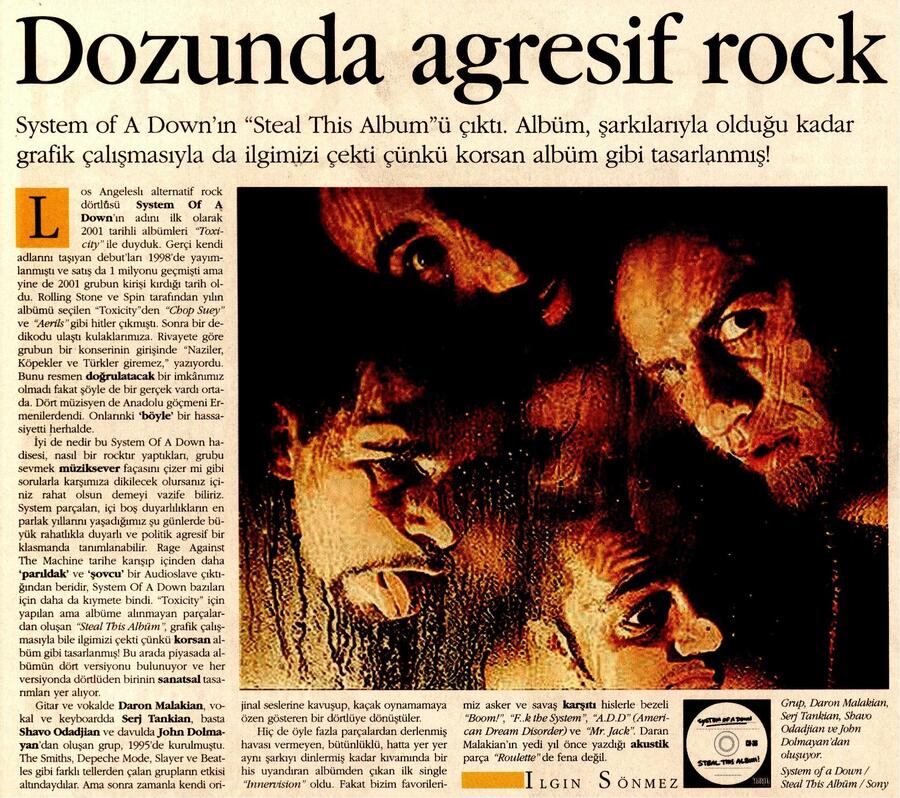
March 16, 2003, Milliyet Kültür Sanat

After the 2003 publication about well-balanced aggressive rock, the band was discussed in Turkish newspapers, but this myth was not mentioned until 2006. Even when we look at the print media archives from 2000 to 2003, we do not find any negative mentions of them.
However, between 2005 and 2006, discussions of this myth began to spread from one platform to another.
In the 2000s, discussion forums became hotbeds of debate, with the band frequently mentioned in connection with these claims. It’s possible to find discussions on numerous platforms including Ekşi Sözlük, Uludağ Sözlük, Donanım Haber, and Reddit. Aside from these sites, debates also took place on music-focused websites. Remarkably, this claim even made its way into a parliamentary motion in 2008. The motion, which questioned whether SOAD was opposed to representing Armenia at Eurovision, claimed that the band used the phrase “no Turks and dogs allowed” at their concerts abroad.
However, no evidence confirming these allegations has been found in either print media or online. Instead, it is presented as a widely accepted truth. Additionally, the constant circulation of the myth has led to variations in the story.

What does SOAD say?
The band has indeed responded to these longstanding rumors. In a 2015 interview with the BBC, John Dolmayan, a member of SOAD, firmly refuted the claims, stating:
“First off, if I had ever witnessed such a thing, I would have put an immediate stop to it. Such behavior is utterly disrespectful. No one's flag should be burned — it doesn't matter whether they're Turkish, Armenian, Lebanese, or American patriots. Secondly, I would never resort to calling someone a "dog." We categorically reject any form of hate speech. If you take a look at my Facebook page, you'll see that I quickly shut down any attacks based on nationality, sexual orientation, or any other personal attribute.”
Dolmayan also revealed that the band had hoped to perform in Türkiye but failed to receive any response from the authorities.
In addition to the drummer’s comments, a statement was found on a fan page. According to the fan page, SOAD had made an official statement on their website addressing the claims in question. However, due to the absence of a specific date and changes to the website over the years, the news section on SOAD’s official site is now inaccessible.

A post announcing that System of a Down refuted the claim on their official website
When we search the phrases in English with key words, two different websites emerge. Like the fan page, both websites state that SOAD has denied the claims. These sites offer an important clue: the statement in question likely dates from around the time the claims were made public. Thanks to the dates provided on these pages, we can narrow down the timeframe to search on SOAD’s website.
Using the Wayback Machine to explore this timeframe, we find a statement from June 20, 2006, refuting the ticket incident.
The full statement is as follows:
“The Turkish media has been spreading blatant lies about System Of A Down, among them the claim that we had an anti-Turk slogan printed on tickets during our 1998 tour with Slayer.
The truth is that System Of A Down cancelled our shows opening for Slayer in Türkiye in 1998. Any tickets for the Turkish portion of the 1998 Slayer tour were printed on Slayer's behalf, not ours. In fact, there were no Anti-Turkish slurs printed on any tickets for that, or any other tour involving System Of A Down.
System Of A Down wishes that the media in Türkiye, and elsewhere, be conscious of the facts, responsible in their research, honest in their writing, and dedicated to the essential importance of the truth.”
Access to the concert schedules of SOAD and Slayer is also available.

In 1998, System of a Down, as one of the bands performing alongside Slayer, held numerous concerts. According to the Concert Archives website, Slayer performed 54 concerts that year; per the Victims of a Down website, SOAD played around 149 concerts, with approximately 19 of these being joint performances with both bands.
As the band has stated, the segment of the concert in Türkiye where SOAD was to perform with Slayer was canceled. In a statement to the BBC, John Dolmayan revealed that SOAD's managers advised against traveling to Türkiye for security reasons. The Victims of a Down website also lists the concerts they did not attend in 1998.
However, due to the unsubstantiated nature of the claims and the lack of detailed information about what happened, it is challenging to make definitive statements based solely on concert data.
Anti-soad.org: "let's dismiss baseless claims"
In parallel, it appears that the issue was clarified in 2007 on anti-soad.org, a website created in opposition to System of a Down. The site's administrator lists claims for which no evidence exists, pointing out that presenting them as facts is incorrect.

Among these, the administrator mentions the claimed sign saying "No Turks and Dogs Allowed" and highlights the lack of proof for such a claim.
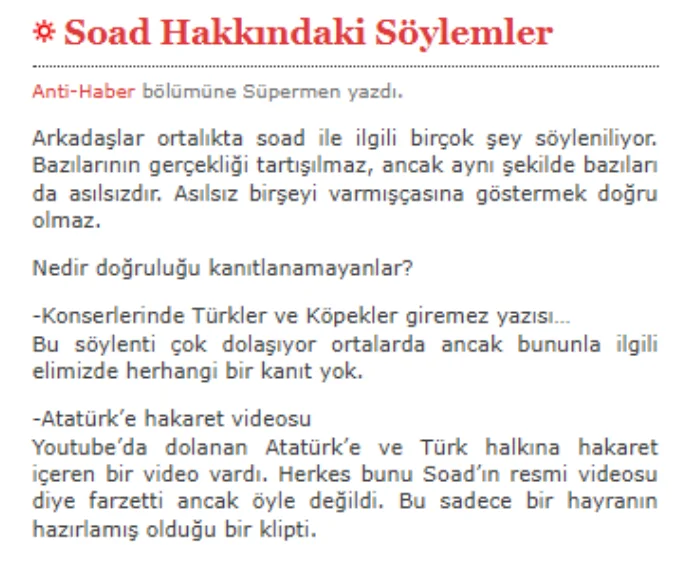
Rumors about System of a Down written in the anti-news section by the user Superman:
What are the unproven claims?
Signs at concerts stating "No Turks and Dogs Allowed"… This rumor circulates widely, yet we have no evidence to support it.
Video insulting Atatürk There was a video circulating on YouTube that insulted Atatürk and the Turkish people. Everyone assumed it was an official SOAD video, but it wasn't. It was just a clip made by a fan.
(...)
What about the claims that have been proven?
Why did I write this article? I want to stop defending things against SOAD fans that we can't prove. We can't convince people with something that doesn't exist. Instead, if we talk about things we can prove, we will be more persuasive.
Regards”
Thus, even the opposition structure established against the band, its "anti," can eventually come to the conclusion that this claim is baseless, and it would be incorrect to accept it as true.
So, how can an urban legend persist for so long without any concrete evidence?
What did we believe in?
Actually, the answer to this question lies more in the psychological and social dynamics supporting the legend than in the legend itself. People tend to believe in stories that resonate with them emotionally or socially. These legends often appeal to individuals' prejudices, fears, or expectations, so we do not resort to skepticism.
For example, the fact that the members of the band in this instance are Armenian could have influenced the belief in this legend. Stereotypes and perceptions of hostility towards Armenians can also play a significant role in the spread of such stories. However, the inferences we make or the urban legends we believe in based on this perception only fuel hatred and hostility between identities.
Because societal prejudices or stereotypes about a specific group can lead us to more readily believe allegations against that group. We feel no need to look into the specifics or reality of claims that confirm our biases; the lack of evidence is also overlooked.
Indeed, the birth of an urban legend often starts with it being heard over and over again and accepted as "true." The more a story is repeated by people, the more likely it is to be believed.
Consequently, when we examine the print media post-2000, we first encounter the legend in 2003 as a rumor and information spread by word of mouth. Resurfacing in 2005, this legend continued to spread in parallel with the band's political statements and actions, taking on different forms as it spread. However, neither a retrospective look can recall exactly what happened, nor is it remembered where the legend actually took place. The only thing remembered is a story that spread without evidence.
We thank the Interpress Media Monitoring Services team for their archival support and collaboration.