

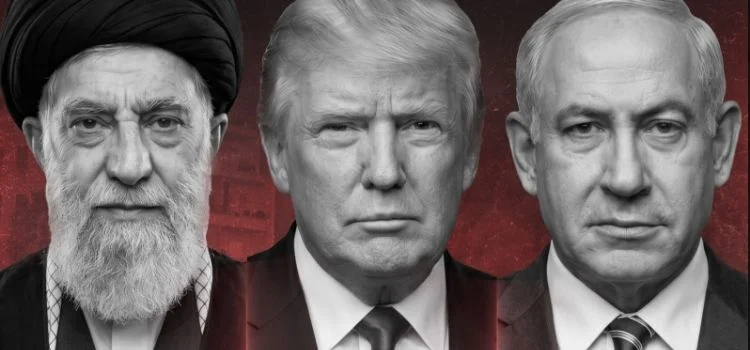

The conflict that began on 28 February 2026 with large-scale US and Israeli air strikes against Iran shook not only military balances but also the information environment. From the very first minutes, social media platforms filled with suspicious imagery, and false content spread across channels ranging from mainstream television to individual user accounts.
"The Anatomy of Misinformation in the US & Israel-Iran War," in which we examine the misinformation that circulated during this conflict, the stories behind it, and the motivations driving it, is out now.
What we looked at
The report compiles 116 analyses published by Teyit over 48 days between 28 February and 16 April 2026. The work looks not only at the information ecosystem in Türkiye but also at the conflict's ripple effects across other countries. Observations from TjekDet (Denmark), Maldita (Spain), Ellinika Hoaxes (Greece), Demagog (Slovakia), and CivilNet (Armenia), together with contributions from Teyit Azerbaijan, map the international information landscape during the conflict.

The oldest trick still works best
One of the report's most striking findings is that false attribution and out-of-date content together account for 63.8% of all analyses. Of the 116 analyses, 56 (nearly one in every two) fell into the false attribution category. Footage from the Syrian civil war, the 2014 Gaza operation, and even the Afghanistan-Pakistan conflict was relabeled and presented as imagery from the current fighting. Despite all the advances in AI, the easiest way to produce misinformation during a conflict remains not creating content from scratch but placing an existing, genuine image in the wrong context.
AI is rising, but it's not the whole story
At the same time, AI-generated content reached a previously unseen level, accounting for 26.7% of all analyses. The 2026 conflict appears to be the first major military confrontation in which generative AI played a central role in shaping public perception.
There was also a notable shift within the two-month period. AI-generated content made up 30% of all analyses in March, dropping to 15% in April. In the same period, false attribution rose from 44.4% to 70%. In the early weeks, when demand for visual content was at its peak, AI came to the fore; as the conflict wore on and demand for fresh footage eased, archive-based content took over.
Across the five surveyed countries, fact-checkers converged on one finding: the goal of misinformation produced during this conflict was often not to make one side win but to muddy the information ecosystem itself.

When TV gets it wrong too
Two striking examples from this conflict showed that false content does not spread only through anonymous social media accounts. It also makes its way onto mainstream television.
On 4 March 2026, CNN Türk aired footage with the caption "Retaliation from Iran / Tel Aviv Live" during its live coverage of Iran's retaliatory strikes on Israel. A location check using Google Maps revealed that the footage was not from Tel Aviv but from the 6 February 2023 Kahramanmaraş earthquake. The channel later acknowledged that the footage had aired "by mistake amid the heavy flow of news and the chaos in the control room."
Sözcü's main news bulletin offered a different type of error. A video claiming to show a cardboard cut-out of Mojtaba Khamenei at an allegiance ceremony in Iran was broadcast under the chyron "Cardboard Cut-out Era in Iran," despite Hive Moderation finding the video to be 91.6% likely AI-generated and Teyit's analysis identifying clear distortions in the Arabic text visible in the background.
Both cases illustrate that information pollution in wartime is not produced solely by bad-faith actors. The pace of news production, the sheer size of visual archives, and the pressure of live broadcasting can lead even established media outlets into error.

This will not be the last
The report shows that while the production of misinformation evolves alongside conflicts, the underlying patterns do not change. False attribution and out-of-date content remain dominant because they are cheap, fast, and persuasive. AI's share is growing, but it has not overtaken traditional methods. When the next conflict comes, the same patterns will play out again.
You can access the full report by filling out the form here.


