

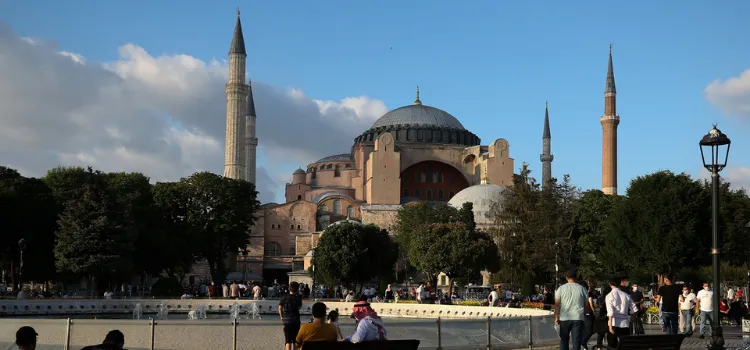

Hagia Sophia, which was converted into a museum by a Cabinet decision in 1934, was reopened for Muslim worship on July 24, 2020, following the annulment of this decision by the Council of State and a Presidential decree.
However, in the early months of 2024, a new regulation issued by the Ministry of Culture and Tourism sparked renewed debates about the status of Hagia Sophia. Under this regulation, tourists wishing to visit Hagia Sophia Mosque for cultural purposes are now required to pay an entry fee. This change has led to renewed discussions, with some social media users criticizing the decision and claiming that Hagia Sophia has "once again been turned into a museum."

Although no specific date is mentioned in the posts regarding the claimed reversion, the discussions started gaining traction in February 2024 and intensified in August 2024.
We examined what the introduction of paid entry for certain sections of Hagia Sophia Mosque really means in the context of its status.
Hagia Sophia has remained a mosque since 2020
Hagia Sophia, which was converted into a museum in 1934 by a Cabinet decision, was reopened for Muslim worship on July 24, 2020, following the annulment of that decision by the Council of State and a Presidential decree.
As of August 21, 2024, no changes have been made to its status as a place of worship, and it continues to function as a mosque.In other words, Hagia Sophia has remained under the administration of the Directorate of Religious Affairs and has held its mosque status since 2020.
New regulation on paid entry for tourists in 2024
On July 10, 2020, President Recep Tayyip Erdoğan stated, “Since its status as a museum is changed, we are canceling the entrance fees. Like all our mosques, its doors will be open to everyone – Muslim or non- Muslim. As the world's common heritage, Hagia Sophia with its new status will keep on embracing everyone in a more sincere way.”

Later, on March 29, 2023, President Erdoğan strongly criticized Temel Karamollaoğlu, the chairperson of Türkiye’s Felicity Party, for suggesting that “a section of Hagia Sophia should be returned into a museum,” responding with the words, “Shame on you.”
However, in early 2024, the Ministry of Culture and Tourism introduced a new regulation requiring tourists visiting Hagia Sophia for cultural purposes to pay an entry fee. As per this decision, only Muslims are allowed into the prayer area, while access to the upper gallery is open to all, whether Turkish citizens or foreigners, for a fee of 25 euros.
Photos show that there are now two divided entrances to Hagia Sophia: one for worship and another for visitors.
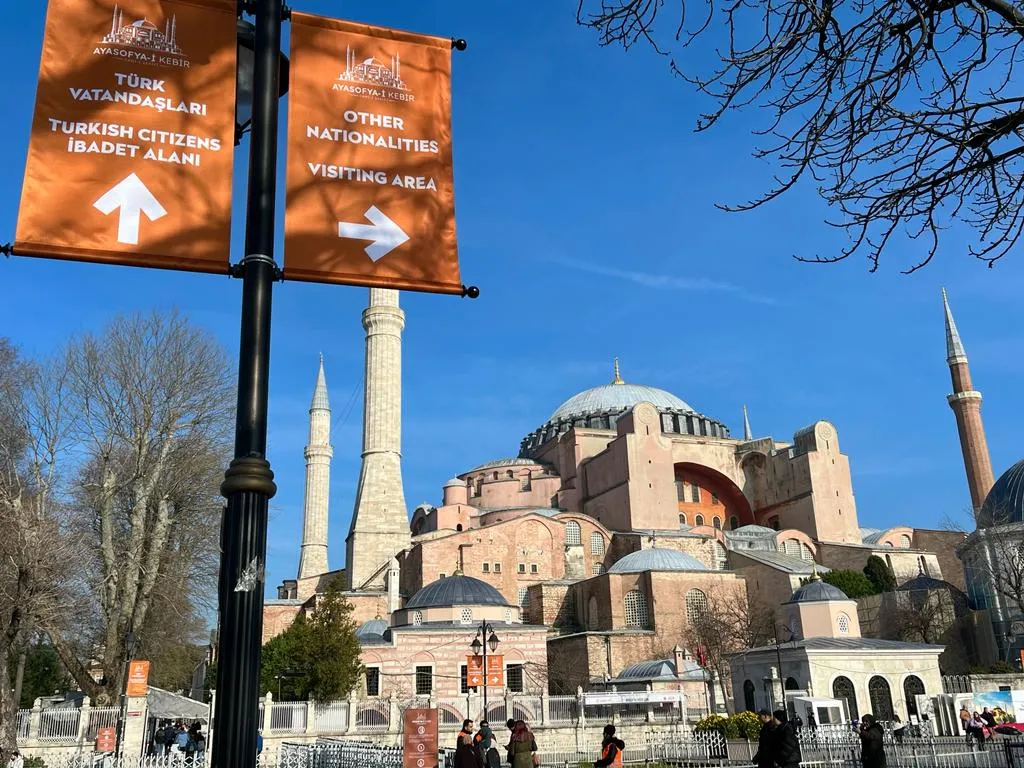
Fotoğraf: Sema Dursun, ArtDog

The section of Hagia Sophia that is not designated for worship and requires a paid entry fee is referred to as the "visiting area." Access to this area is carefully controlled via a tunnel and ramp under the II. Bayezid minaret on the mosque's southern side. After exploring the upper gallery, visitors exit through the northeast ramp.
The first signs of this new policy, which was implemented in January 2024, were hinted at by Minister of Culture and Tourism Mehmet Nuri Ersoy on October 31, 2023. Minister Ersoy announced that, following UNESCO's recommendations, a visitor management plan would be introduced for Hagia Sophia Mosque, with foreign visitors entering through a separate paid route. According to Ersoy, the goal was to divide the entrances for tourists and cultural visitors from those coming for worship.
Anadolu Agency reported that the new system aims to reduce the congestion at the entrances by dividing those coming for prayer from tourists. This allows tourists to visit without disrupting the mosque's atmosphere for worshippers.
What does "visiting area" mean?
A museum is defined as an institution that identifies, uncovers through scientific methods, studies, evaluates, preserves, promotes, and exhibits historical artifacts while raising public awareness about cultural heritage through educational programs. This requires professional museum management for its official status.
Hagia Sophia does not officially hold the status of a "museum"; rather, it is still classified as a mosque. For its official status to be changed, a Presidential decree would be required. However, with the introduction of a paid entry policy, a “visiting area” within the building has been established.
Similarly, the Istanbul Chora Mosque (Kariye Mosque), which was converted from a museum back into a mosque in 2020, has also implemented a new arrangement for visitors. While local visitors are not charged an entry fee, foreign tourists are required to pay for entry. However, like Hagia Sophia, Chora has not been officially designated as a museum.
So, what exactly does "visiting area" for tourists mean? We asked art historian Özgür Ceren Can.
Özgür Ceren Can explained that opening a part of the building for paid entry as a visiting area does not fully equate to it being a “museum.” Can reminded us that Hagia Sophia is still on the World Heritage list and emphasized that, regardless of whether a section has paid entry or not, Hagia Sophia must be preserved according to museum standards. According to Can, this is a unique situation for all places of worship that are also cultural heritage sites.

In Can’s view, the fact that Hagia Sophia functions as a mosque today does not mean it is not being preserved according to international museology standards. While it remains a place of worship, Hagia Sophia is “preserved like a museum,” but having a tourist visitor area does not turn it into a full-fledged museum.
Özgür Eren Can explained that the Ministry of Culture and Tourism’s priority is to protect the building, ensuring that conservation, restoration, and heritage standards are met before putting it to use.
Can pointed out that similar examples can be found both in Türkiye and around the world. For instance, although the Blue Mosque does not charge an entry fee, it is open to tourists outside of prayer times. Similarly, St. Anthony of Padua Church on İstiklal Avenue is accessible to visitors when services are not being held. In both cases, opening the space for visitors doesn’t take away from their primary functions as places of worship.
What sets Hagia Sophia apart from these examples is the fact that a section of it requires a paid entry fee. According to Can, charging for admission is quite normal in Hagia Sophia’s case because, given the building’s age and structural characteristics, it’s essential to control the number of visitors.
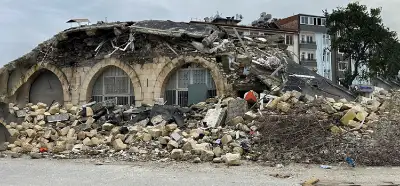
In short, Hagia Sophia today serves both as a place of worship and a cultural heritage site. The aim is to preserve it as a historical monument while balancing both tourist needs and the continuation of religious practices.
Debates sparked over the new regulation
The new arrangement has sparked debates both within the public and in the Turkish Grand National Assembly (TBMM).
On January 30, 2024, Türkiye’s Future Party (GP) MP for Denizli province, Sema Silkin Ün, submitted a parliamentary question regarding the decision to charge 25 euros for entry to the upper gallery of Hagia Sophia for both local and foreign tourists. She posed several questions, including: “Is Hagia Sophia still officially a mosque? Or is it a museum? Are there any other places of worship in our country where entry tickets are sold? Considering the current state of the economy, will Turkish citizens be offered a discount?” So far, these questions have not been answered.
On April 17, 2024, Sema Silkin Ün reiterated her questions during a general assembly session concerning Hagia Sophia's current status. Özlem Zengin, the deputy of the Justice and Development Party (AK Party) dismissed the inquiry, calling it "absurd" and stating: We read the Presidential decree concerning the designation of Hagia Sophia as a mosque in the general assembly on July 24, 2020. Asking a question about an issue that does not exist is simply an attempt to create a public tension."

The core of the criticism isn’t necessarily about Hagia Sophia regaining its "museum status." Rather, the controversy centers on the building being treated as a tourist site that, while not officially designated as a museum, is operating like one in practice. This "in-between" status is seen by some as problematic.
On social media, comments like “If it’s a mosque, why are tickets being sold? If it’s a museum, why is it still called a mosque?” reflect the mixed reactions to the arrangement.
Hagia Sophia History and Experience Museum: A Separate venue in Sultanahmet
It’s also important to note that the Hagia Sophia History and Experience Museum has been opened in the Defter-i Hakani Nezareti building. However, this museum is not located within Hagia Sophia itself but in a separate building near Sultanahmet Square, completely distinct from the mosque.
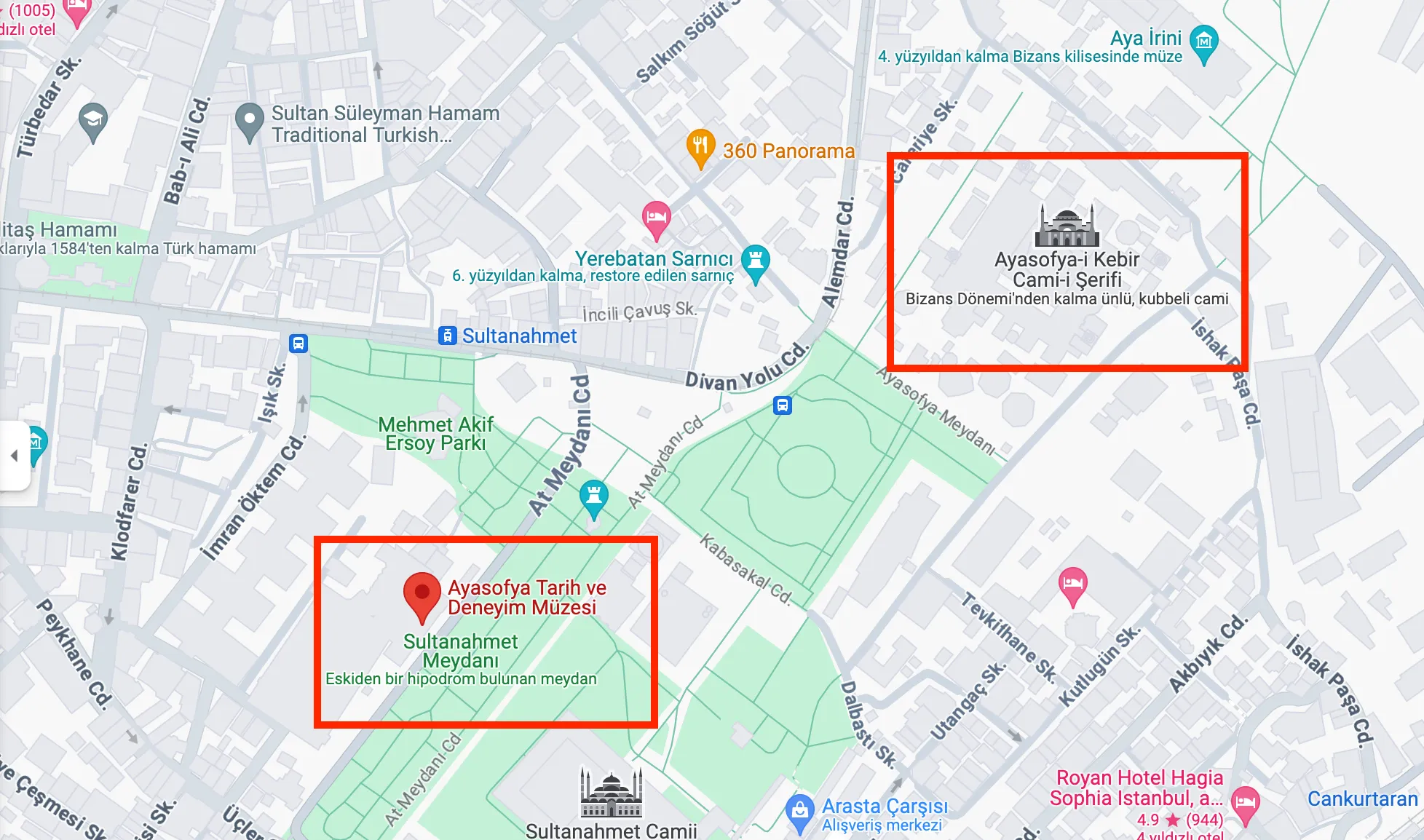
Managed by DEM Museums, the Hagia Sophia History and Experience Museum explores Hagia Sophia’s nearly 1,700-year history, with each floor highlighting a different era. The third floor showcases the Roman Empire period, while the second floor focuses on the Ottoman period through visual and audio presentations. The first-floor features artifacts, many of which are being displayed for the first time.
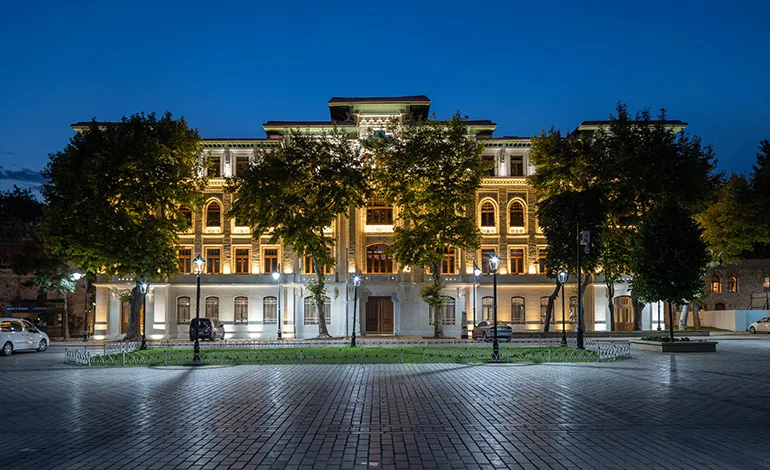
The entrance fee is 425₺ for MuseumPass (Müze Kart) holders, 800₺ for Turkish citizens without a MuseumPass, and 25 euros for foreign tourists.

What makes Hagia Sophia a point of debate?
Hagia Sophia, originally built as a monastery around 1,500 years ago, holds deep significance for Christians as a sacred site. Following the Ottoman Empire’s conquest of Istanbul, the building was converted into a mosque, and it has since become a sacred place for Muslims as well.
For nearly 900 years, Hagia Sophia served as a church, over 400 years as a mosque, and for 85 years it functioned as a museum. Given this long and varied history, debates about its status have been ongoing for many years.
Some argue that, due to its role in housing different religious and cultural identities throughout history, Hagia Sophia should now be regarded more as a historical and cultural site rather than an active place of worship. On the other hand, others believe it is the building's rightful purpose to serve as a mosque.
When Hagia Sophia was converted back into a mosque in 2020, the decision drew significant international attention.
Countries such as Greece, Russia, and Orthodox Christian communities, in particular, voiced their disapproval. The change in Hagia Sophia’s status, which is listed as a UNESCO World Heritage Site, also prompted criticism in terms of cultural heritage preservation and interfaith dialogue.
Conversely, nations like Malaysia, Qatar, Iran, Pakistan, Oman, Palestine, and the Turkish Republic of Northern Cyprus (TRNC), as well as some Islamic communities, expressed support for the move to restore Hagia Sophia as a mosque.
Before this transformation, President Recep Tayyip Erdoğan had signaled that the change was imminent through several statements. In 2017, the Directorate of Religious Affairs held a program for Laylat al-Qadr (the Night of Power) in Hagia Sophia, and in 2018, during the opening ceremony of the Yeditepe Biennial Festival at the Hagia Sophia Museum, Erdoğan’s speech was preceded by a recitation of the Quran. These events were seen as indicators that Hagia Sophia would eventually be reconverted into a mosque.